The Traefik Labs Manifesto: The Case for a Unified Runtime Layer

Modern infrastructure has built itself into a corner.
Over two decades of rational technology choices have produced an irrational result: a fractured architecture that slows development, complicates security, and prevents organizations from operating at the speed their business demands. This is not a problem we can optimize our way out of. It requires a fundamental shift in how we think about application infrastructure.
We believe the enterprise needs a unified runtime layer, not as a future luxury, but as an immediate necessity.
This is Traefik Labs' position. We have built our entire platform around this belief, and the industry is starting to recognize why it matters.
The Problem: Fragmentation Has Become the Default
Modern organizations run on a mosaic of execution environments: virtual machines, Kubernetes clusters, serverless platforms, public clouds, private clouds, sovereign regions, and edge locations. Each environment comes with its own governance model, networking assumptions, security policies, and operational culture. Each choice made sense in isolation. Collectively, they created chaos.
Every environment has its own ingress pattern, every system its own access rules, every team its own API conventions. Every workflow must navigate inconsistent connectivity, and every security model must be re-implemented. We have normalized dysfunction.
Developers spend more time wiring systems together than building features. Security teams struggle to enforce policies across incompatible platforms, while operations teams manage overlapping tools that don't talk to each other. We tell ourselves this is the cost of innovation, but in reality, it is the cost of fragmentation. It is holding the enterprise back.
The Tipping Point: AI Cannot Tolerate What Humans Have Learned to Ignore
Humans have learned to socially engineer solutions to these roadblocks; we open tickets, manually bridge gaps, and route around broken systems. AI cannot do this.
While an LLM can instantly adapt to a changing API schema or logic flow, it cannot bypass the hard physics of the network. When an AI agent hits a firewall, a missing route, or an ambiguous identity policy, it cannot "negotiate" access. It simply fails.
Agentic systems require stable APIs, trustworthy identity, predictable governance, end-to-end visibility, context-aware access, and consistency across environments. They need what the enterprise has historically struggled to provide: a coherent runtime.
AI is no longer confined to specialized projects; inference is becoming ubiquitous. Every application will soon make calls to language models, vision models, embedding models, and specialized AI services. These inference workloads will sit alongside traditional API traffic, demanding the same reliability, security, and observability as mission-critical services require today.
Agentic infrastructure is not creating a new problem. It is exposing the problem we have been tolerating for years, serving as the stress test that proves the current model is broken and forcing the conversation we should have had long ago.
The infrastructure that served the last era cannot serve the next one.
The Solution: A Unified Runtime Layer for All Workloads
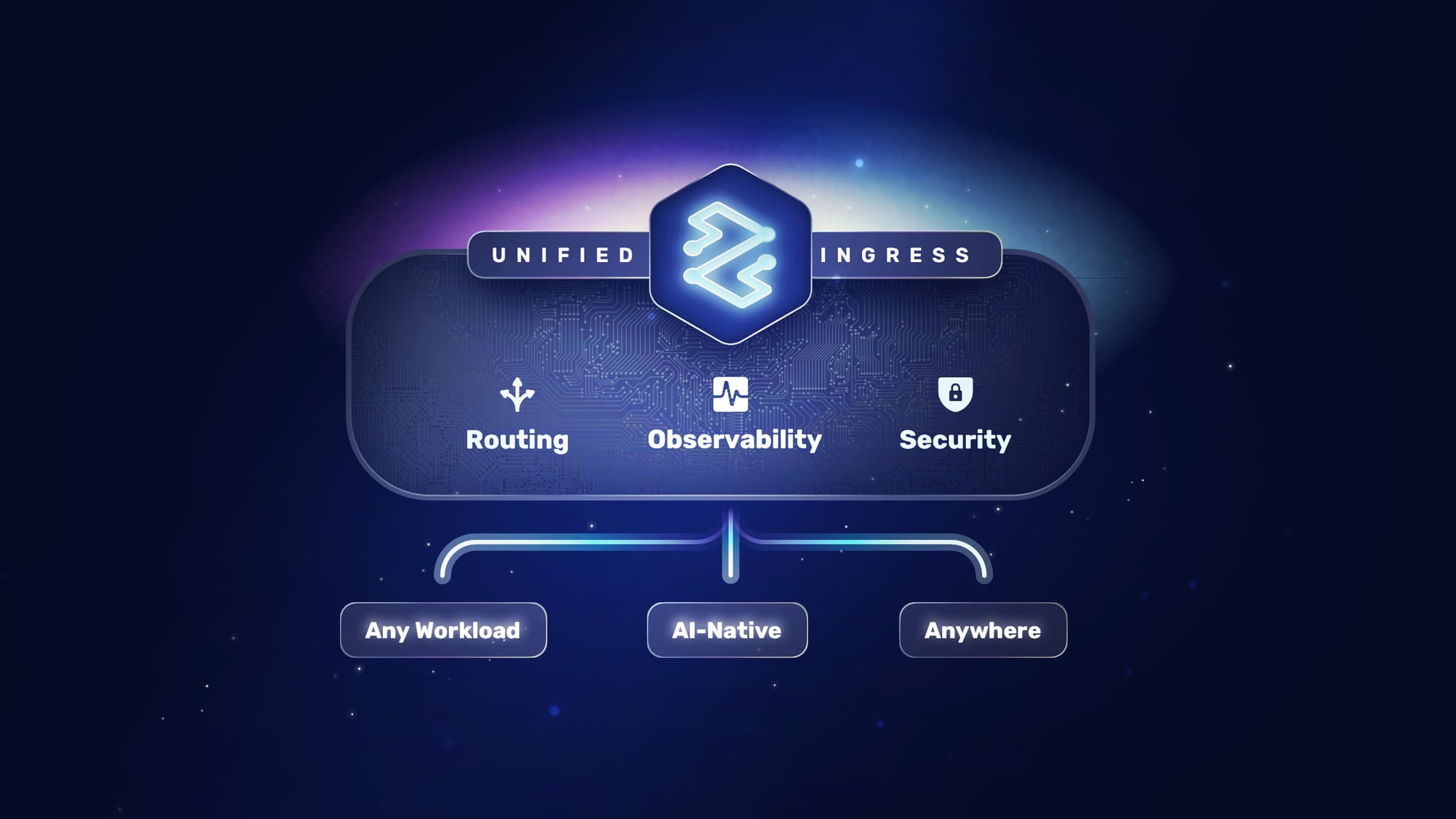
A unified runtime layer sits above the execution environments but below the application logic. It standardizes how traffic flows, how identity is enforced, how APIs are exposed, how workloads are protected, and how intelligence is applied. Rather than replacing infrastructure, this approach brings coherence to it.
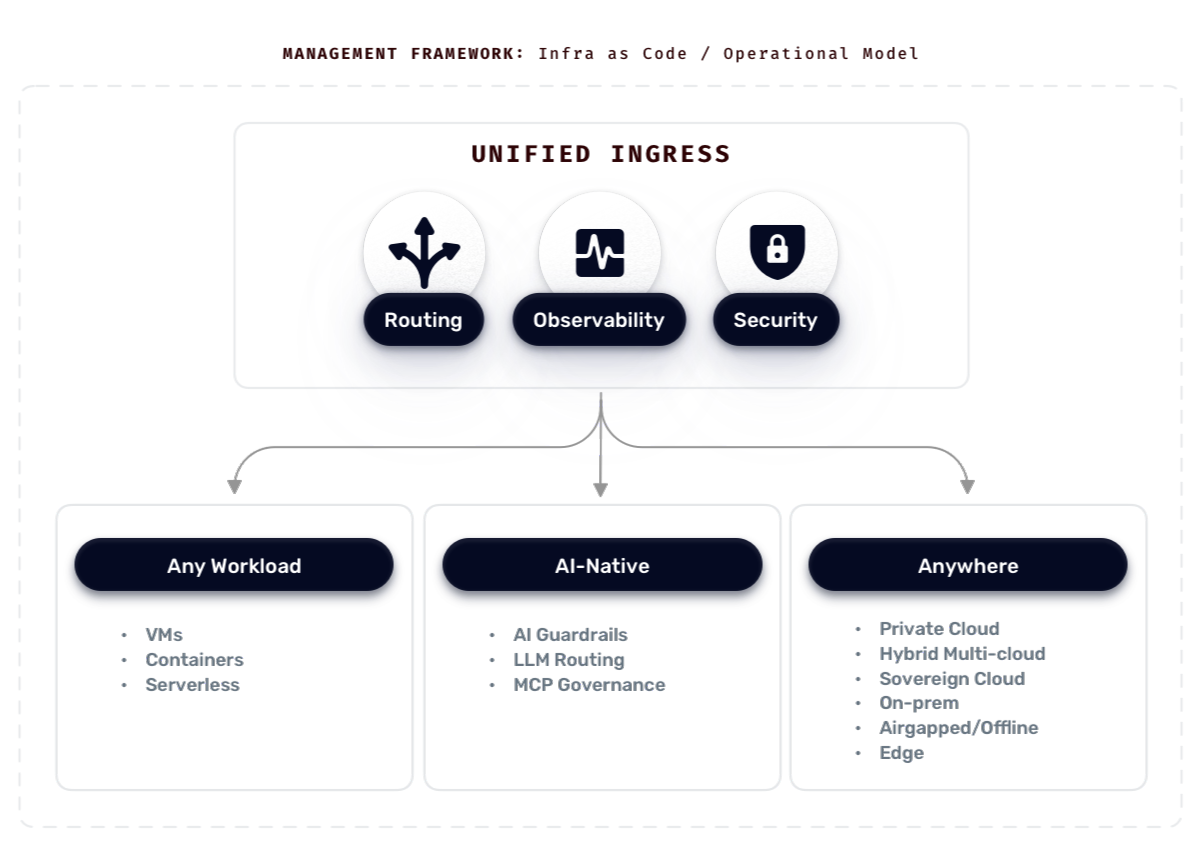
Our Principles
- Consistent governance everywhere. Policies must be defined once and applied universally across Kubernetes, VMs, and edge nodes. By enforcing standards like OAS (OpenAPI Specification) at the definition level, we transform loose integrations into strict, governable contracts.
- Universal connectivity. VMs, containers, functions, and legacy systems must behave like a single addressable estate. Connectivity is not negotiable. It is the baseline requirement for everything that follows.
- Intelligent routing by default. Modern workloads need more than Layer 7 routing. They need context-aware decisions, semantic caching, and policy enforcement that understands intent rather than just packets.
- Security as a standard, not an add-on. Security policies are agnostic to the underlying infrastructure. No exceptions, no workarounds, no environment-specific compromises.
- Complete observability across all traffic. Every request, response, and failure must be traceable. Without observability, there is no understanding. And without understanding, there is no control.
- Sovereignty and edge readiness. The runtime must function wherever the enterprise operates: global cloud regions, regulated environments, private clusters, and air-gapped infrastructures. Geography cannot break the model.
- Developer experience is not cosmetic. If it is hard to use, it will not be used. Simplicity is a requirement for adoption, never a compromise on capability.
These principles define the application fabric enterprises need. They make applications more reliable, security more robust, and create the foundation AI requires to function.
The Traefik Vision: Application Intelligence as the Connective Layer
At Traefik Labs, we’ve spent years building the Application Intelligence Platform: a unified runtime solution that acts as the connective, governed, and intelligent layer for all application and AI traffic across an enterprise.
Our product suite embodies this vision:
- Traefik Proxy unifies ingress, routing, and traffic management across containers (Kubernetes, ECS, Swarm, Nomad, etc.), VMs, and hybrid architectures.
- Traefik API Gateway brings consistent identity, policy enforcement, and visibility to every environment.
- Traefik AI Gateway manages AI inference traffic as a first-class workload, handling guardrails, cost controls, and semantic caching.
- Traefik MCP Gateway ensures agentic AI systems interact with enterprise infrastructure safely and predictably.
- Traefik API Management provides comprehensive governance, from developer portals to GitOps-driven operations at scale.
Together, they form a coherent architecture. Organizations can start with any Traefik Labs product and add capabilities seamlessly, in seconds, as requirements change. This makes our entire suite less a collection of tools and more a platform with a clear point of view.
Why This Matters
The organization that unifies its runtime layer will move faster, operate more securely, and adopt AI more confidently than those still managing fragmented infrastructure. This is a present requirement, not a distant future state.
Organizations are realizing that the runtime is the control plane for modern applications. Governance is the foundation, not a feature. Connectivity must be consistent everywhere, and APIs have become the enterprise's most critical interface. AI inference workloads will flow through the same infrastructure as every other service, requiring unified observability.
The question is no longer whether to unify, but when.
Our Commitment
Traefik Labs has always believed that connectivity should never be the limiting factor for innovation. As the enterprise enters the age of AI, this belief matters more than ever.
We have built the unified runtime layer that addresses the fragmentation enterprises face today while enabling the intelligent workloads they are deploying now. This architecture spans clouds, data centers, VMs, and edge, with a foundation in open standards and enterprise-grade reliability.
This is the foundation the industry needs. This is the architecture we have built. This is the future we are committed to advancing.
The unified runtime layer is no longer optional; it is the foundation that makes everything else possible.