One Factory. One Runtime. Every Call Governed.


Traefik Hub and SUSE AI Factory Introduction Video
Enterprise AI is not short on ambition or models. It is short on infrastructure.
Infrastructure is the rate limiter of enterprise AI. GPU capacity is scarce, and the organizations that have secured it are under pressure to put every GPU hour to work. But infrastructure is more than hardware. Before a single model call reaches production, someone has to architect who is calling, what they may do, what data leaves, and what it costs. That is governance, and it is as much a part of AI infrastructure as the GPUs themselves. It is also the part most often left for later.
SUSE AI Factory with NVIDIA is the foundation of that infrastructure. It brings GPU compute, Kubernetes, the AI applications, and the tools to manage them together into one system that an enterprise owns and operates. Traefik Hub is its runtime: the layer every model call and every agent action passes through. Each company brings what it does best, and together they cover AI infrastructure from the GPU to the governed call.
Governance does not belong inside each application. It belongs at the runtime layer, the one place every model call and every agent action passes through. That is the premise behind Traefik Hub. Today, Traefik Labs and SUSE are bringing it to SUSE AI Factory with NVIDIA: Traefik Hub is now certified for SUSE AI Factory with NVIDIA and available as partner blueprints, so every customer running the factory can govern it from the same catalog they build it from. SUSE builds and runs the factory. Traefik Hub governs every call inside it.
Governance Inside Every App Is Governance Nowhere
Look inside a typical AI deployment, and the pattern is the same. Each application calls models with its own shared key. Each one carries its own idea of who may use which model. Sensitive data in a prompt is copied to the model, the cache, and the logs before anything can mask it. GPU spend has no owner.
Agents make it worse. An agent does not click through a user interface that hides the dangerous buttons. It calls tools directly over the Model Context Protocol, at machine speed, against servers that often carry no authorization logic of their own.
This is not a tooling gap. It is an architecture gap. Every application that implements governance on its own is one more place where it drifts, one more review for the security team, and one more reason the launch slips a quarter.
Seven Questions, One Gateway
Before AI goes live, executives ask the same seven business questions, from the CISO to the CFO. Traefik Hub answers each one at the gateway, on every request, for people, applications, and agents alike.
Who is calling? The AI Gateway validates the token from the enterprise identity provider on every request. Every model call carries a real identity, not a shared key.
What may they do? The gateway decides access before any inference happens. Groups get the models they are entitled to and nothing else. For agents, the MCP Gateway applies tool-based access control: an agent is shown only the tools its identity may use, and any call to another tool is refused before it reaches the server.
Is sensitive data leaking? Content guards mask e-mail addresses, card numbers, phone numbers, API keys, private keys, and known prompt-injection phrases before any model, guard, or cache sees the prompt, and again on the answer. Safety models run in parallel at the gateway, from Llama Guard to the NVIDIA NeMoGuard NIM microservices for content safety, topic control, and jailbreak detection, so the gateway stops an unsafe request before spending a single token.
What is it costing us? Every token is metered against budgets per user and per team. A semantic cache answers repeated questions without touching a GPU, and NVIDIA NeMo Switchyard lets the gateway send each request to an efficient model, saving the most capable models for the turns that need them. Scarce capacity goes to the work that needs it.
What happens when a model fails? The gateway routes around it. When a model is unavailable, Traefik Hub sends the request to another one, and the application keeps working. The user never sees the failover.
Can we prove what happened? Every decision the gateway makes, whether allowed, refused, or masked, is traced in one place.
Can we change models without breaking anything? Applications talk only to the gateway. They hold no model keys or authorization code, so you can upgrade, move, or replace models behind Traefik Hub without changing the applications.
Seven questions. One gateway. No application rewrites.
The Layer That Does Not Fragment
Models will change. Frameworks will change. Agent protocols will keep evolving. The traffic layer is the one part of the AI stack that every one of those choices has to pass through, which makes it the one place where governance survives them.
One Runtime for APIs, Models, and Agents
Traefik Hub is the same runtime for the APIs a business already runs, the models it now calls, and the tools its agents use. The AI Gateway governs model traffic, the MCP Gateway governs agent tool calls, and the API Gateway protects the front doors, with a web application firewall in front of the chat, sign-in, and tool interfaces. One set of policies. One audit trail. One enforcement boundary.
Policy as Code, Native to Kubernetes
Every Traefik policy is a Kubernetes resource: plain YAML, reviewed, versioned, and rolled out like any other change. Platform teams govern AI with the processes they already trust.
Built for Sovereign AI
Traefik Hub runs entirely inside the customer's own clusters, next to their data and their models. Governing AI never requires sending a request somewhere else.
Proven in Open Source
Traefik Proxy, the open-source foundation of Traefik Hub, has more than 3.5 billion pulls. Enterprises already trust it with their traffic; now they can extend that trust to AI.
The Partnership: Governance Built Into SUSE AI Factory with NVIDIA
SUSE and Traefik Labs start from the same conviction: enterprises should own their AI platform, not rent it. Both companies are built on open source and on Kubernetes, and both serve organizations that need to keep data, models, and decisions under their own control. SUSE AI Factory with NVIDIA gives those organizations the foundation: GPU clusters, a catalog of one-click blueprints, and data and models kept in-house, all managed in Rancher and rolled out by Fleet. That is exactly where runtime governance belongs.
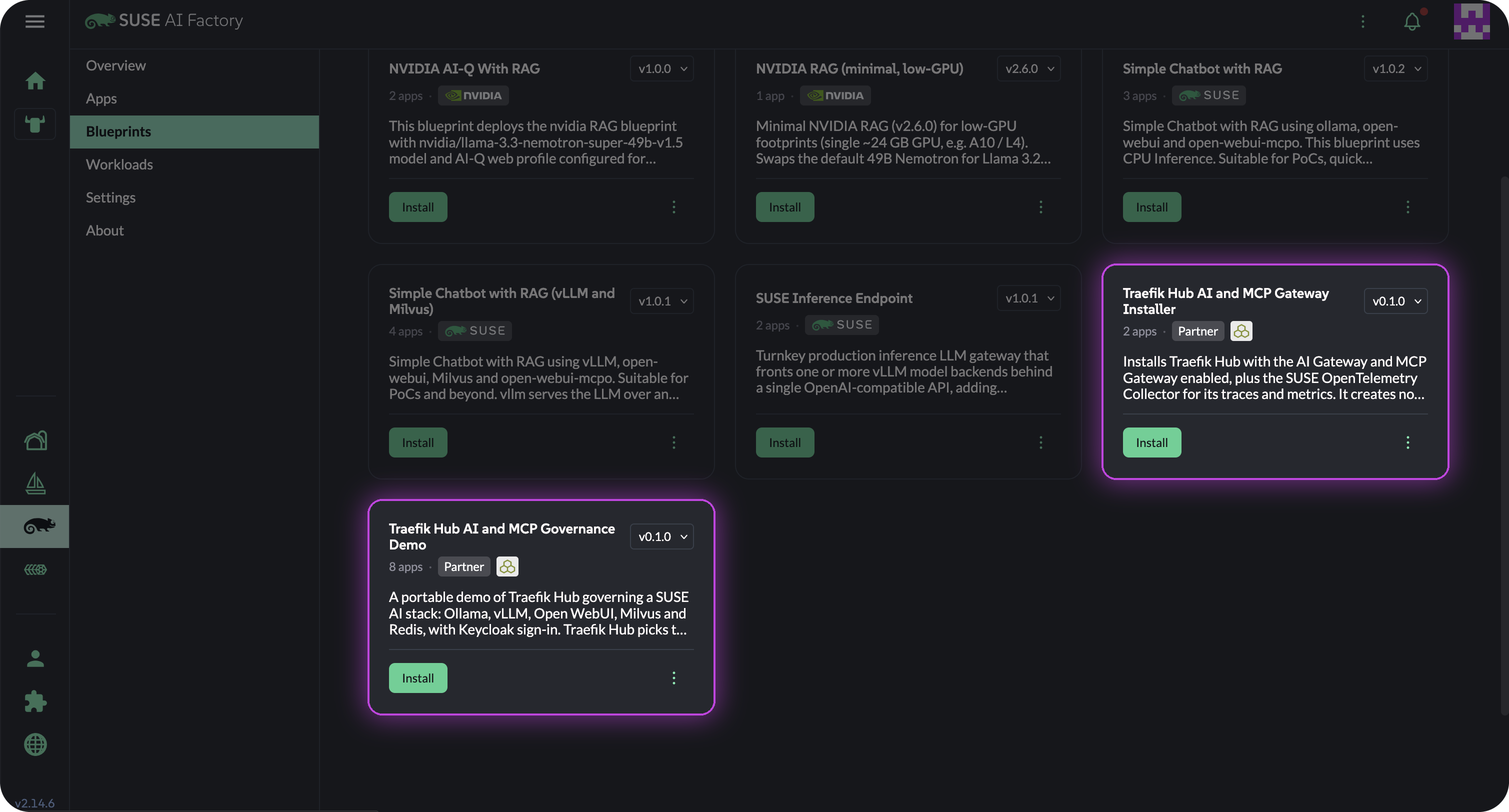
So the integration was built the SUSE way. The Traefik blueprint sits in the SUSE AI Factory catalog beside SUSE's own blueprints. A platform team installs it in one click, and Fleet carries it to every selected cluster and keeps it upgraded. The stock SUSE AI applications—Ollama and vLLM for inference, Milvus for vectors, Redis for counters, and Open WebUI for chat—stay exactly as SUSE ships them. Every Traefik policy lives in one small Helm chart beside them, so the same gateway governs the GPU models vLLM serves and the CPU models Ollama serves. SUSE engineers built the first version of the blueprint with Traefik Labs, and it feels native to SUSE AI Factory because it was designed to be.
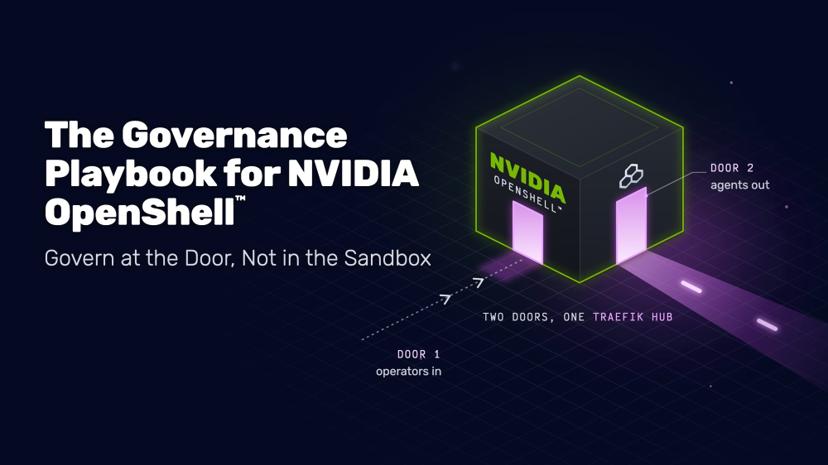
The integration reaches into the NVIDIA side of the stack as well. Traefik Hub runs the NVIDIA NeMoGuard NIM microservices as safety guards at the gateway and uses NVIDIA NeMo Switchyard to choose the right model for each request. For agents running in NVIDIA OpenShell sandboxes, which SUSE AI Factory integrates, Traefik Hub governs both doors: who gets in to operate the sandbox, and what the agents inside it may reach.
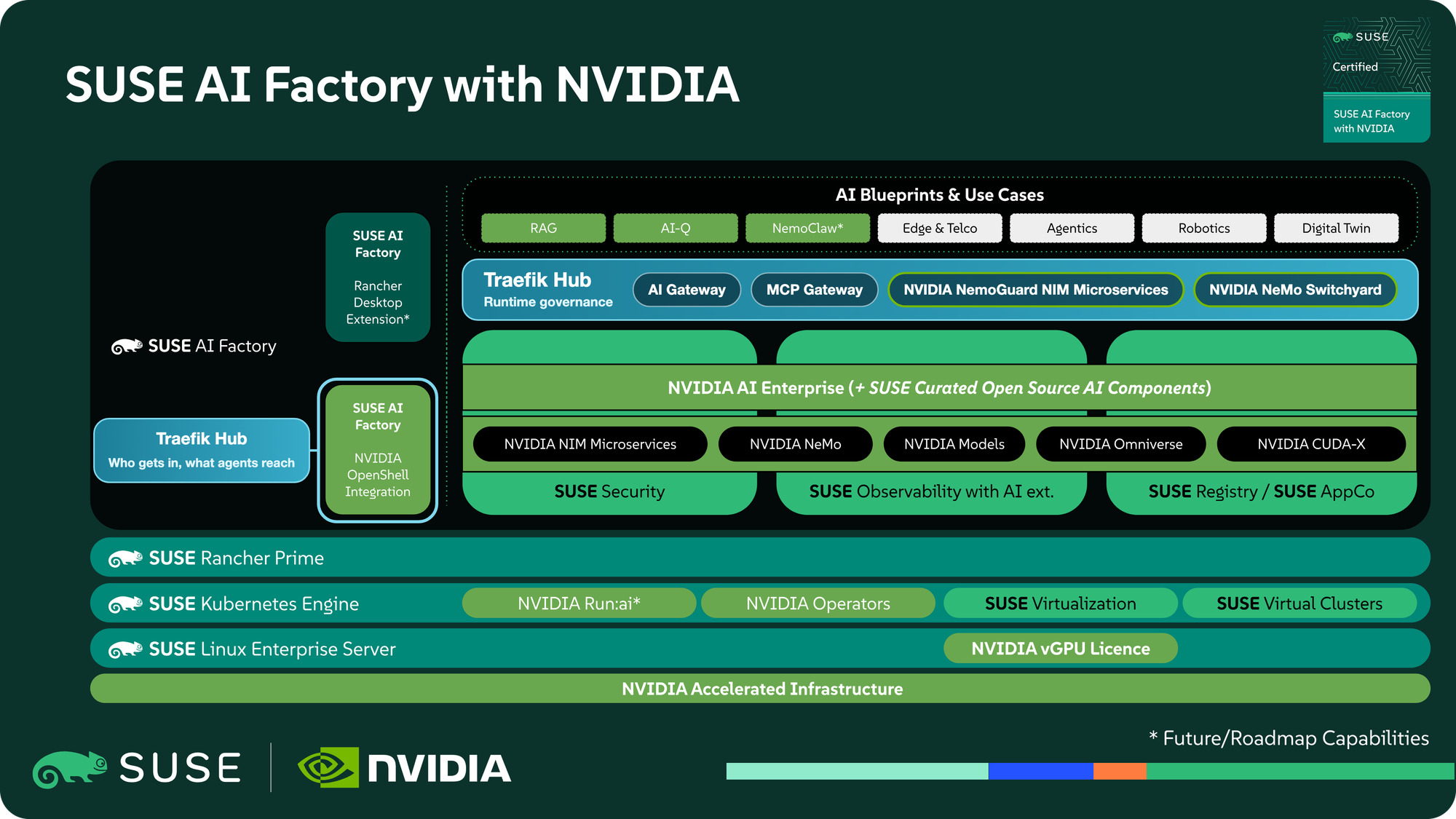
The support model is just as clear. SUSE stands behind the factory. Traefik Labs stands behind the blueprint and the gateway. Customers get one integrated stack, and each part is backed by the company that builds it.
How SUSE and Traefik Labs Help Customers Together
Together, the two companies give enterprises a complete answer to the infrastructure question: the compute, the platform, and the governance to run AI in production.
From Pilot to Production, Faster
SUSE puts the AI stack in place in one click. Traefik Hub adds the controls. The platform answers the questions that stall a launch in security review, so you don't reopen them for every application.
Sovereign, End to End
SUSE keeps data and models on infrastructure the customer owns. Traefik Hub keeps governance there too. No request has to leave the factory to be authorized, screened, or metered.
Every GPU Hour Accounted For
SUSE delivers the GPU capacity. Traefik Hub decides who may use it, meters every token against team and user budgets, and serves repeated questions from cache, so scarce capacity goes where the business needs it.
One Way of Operating
Platform teams manage the factory in Rancher and roll it out with Fleet. Traefik policies are Kubernetes resources in the same workflow. Governance becomes one more blueprint, not one more project.
Agents Ready for Production
SUSE runs the models, the tools, and the NVIDIA OpenShell sandboxes agents work in. Traefik Hub's MCP Gateway makes sure every agent can reach only the tools its identity allows, with every call on the record.
Three Steps, One Gateway
Here is what that looks like on SUSE AI Factory, in three steps, all through one gateway.
- The Wiring. The platform team adds Traefik Hub to SUSE AI Factory as a blueprint, in one click, and Fleet rolls it out to the clusters it picks.
- The Proof. A developer and an admin open the same chat application, and Traefik Hub gives each of them a different answer. The developer asks for an admin-only model and is turned away at the gateway before any inference happens. A personal e-mail address in the admin's prompt comes back masked. An unsafe request is stopped with no tokens spent.
- The agentic workflow. Then an agent goes to work, with no human in the loop. With the admin's token, it sees five tools and restarts a model. With the developer's token, the same agent on the same MCP server sees three tools, and the privileged ones simply do not exist for it. When it tries to restart the model anyway, Traefik Hub refuses the call before the server ever sees it. The MCP server holds no authorization code of its own.
Three identities. One chat application. One gateway deciding and logging every call. See it in action, the three-step walkthrough video:
The Architecture Choice That Gets Made Once
Every AI factory will eventually have governance. The only question is where it lives. Put it in the runtime on day one, and it is a blueprint install. Put it off until fifty applications each hold their own keys and their own rules, and it becomes a migration project.
Start: your first AI application. Govern it from day one. Install the Traefik blueprint and put the first chat application behind it. Identity, data protection, safety, and budgets are in place from the first request.
Scale: every team, every cluster. Fleet rolls the same blueprint and the same policies out to every cluster. A new team gets a group and a budget, not a new integration project.
Agentify: tools with no human in the loop. Put MCP servers behind the MCP Gateway, and every agent is held to the same identity-based rules as the people it works for.
Build the Factory Once. Govern Every Call From Day One.
Infrastructure is the rate limiter of enterprise AI. SUSE brings the foundation: the compute and the platform. Traefik Labs brings the runtime that governs every call on it. Together, you have an AI factory ready for production, from the first request.
The enterprises that win with AI will not be the ones with the most pilots. They will be the ones whose CISO, CFO, and platform team can say yes on day one, because every model call and every agent action already answers to the same seven questions. That is what this partnership delivers.
Here is how to take the next step.
See it. Watch the detailed walkthrough video: the wiring, the proof, and the agentic workflow, on SUSE AI Factory, in under ten minutes.
Run it. Stand up SUSE AI Factory with the SUSE AI quickstart, install the Traefik blueprint from the catalog, and govern your first AI application from day one.
Plan it with us. Your SUSE and Traefik Labs teams can show you how, on your own applications, agents, and clusters. Contact us directly, or learn more about Traefik Hub's AI Gateway and MCP Gateway.
Meet us. Come meet us at GTC Berlin October 20-22, and at KubeCon + CloudNativeCon North America, November 9-12, in Salt Lake City.
The AI factory is ready. Now it’s time to make it governed.